Showing posts with label nostalgia. Show all posts

Tuesday, 15 April 2014

Multiculturalism in the Monster Kingdom: Part I

Race, Religion, and Culture in Majesty: The Fantasy Kingdom Simulator

This two-part informal essay was written to be one post, but it wound up far too long, so I have  broken it into two parts. This first part will simply explain the mechanics of the computer games I will discuss, and why they appealed to me; if you are familiar with both Majesty and Majesty 2, I imagine you could skip right to Part II, though it might be good for you to read this one if you want to know how I am framing them for discussion.

Paradox Interactive’s Majesty 2 is the sequel to Cyberlore’s Majesty: the Fantasy Kingdom Simulator; the first Majesty was my favourite game for most of my life and still ranks in at least the top three. Both games are real-time strategy games (RTSs), putting you in the role of the Sovereign of a kingdom in a fantasy world called Ardania. You can order the construction of buildings and the research of improved technology. You can recruit heroes to defend your kingdom and enforce your decrees. You can set tax and building repair policies. You can commission spells from local temples and wizard’s guilds. As Sovereign, you attempt to complete quest, which usually involves building up a settlement, earning gold, and, invariably, trying to rout out the enemy monsters and defend your village against dragons, ratmen, goblin hordes, and the like.

What sets the Majesty games apart from other RTSs, however, is that you cannot directly control your heroes; instead, you can try to motivate their behaviour using reward flags (in the original, only Attack and Explore flags; the sequel adds Defend and Avoid flags), providing them with equipment, and constructing specific buildings which promote certain behaviours. You also carefully choose which heroes to recruit: Warriors tend to be stalwart and aggressive; Rogues are cowardly but highly motivated by gold, and also tend to steal from you; Rangers prefer to explore above all else and will; Paladins are stubborn and tend to take on foes well out of their league. (If you can’t tell, the franchise draws heavily from D&D.) These quirky, flawed, endearingly predictable, and frustratingly autonomous heroes are the heart of the game; the storylines leave much to be desired, but that’s usually fine given the minor dramatics your heroes will be getting into spontaneously.

In the original Majesty, there were three non-human races[1] you could recruit—elves, dwarves, and gnomes—but since elves and dwarves shared a mutual enmity, and neither of them cared for gnomes, you would have to choose only one. Which you chose would have an effect on your whole settlement, since if you chose dwarves, you could then defend your settlement with much superior defense towers; if you chose elves, your economy would grow but gambling halls and elven “lounges” (thinly veiled brothels) would pop up; and if you chose gnomes, slums would appear. In a subtle but important way, which non-human race you chose would influence your settlement’s culture, both cosmetically (lots of blue-tiled roofs if you choose elves) and mechanically (everything will be in good repair if you choose the handy gnomes).

And there was more: you could build temples to the assorted deities of Ardania, but these gods (and their followers) had a complex set of alliances and rivalries which meant that by building certain temples, you prevent yourself from building some of the others. For example, if you build a Temple to Dauros, god of law and commerce, or a Temple to Agrela, goddess of life, you can no longer build a Temple to Fervus, god of chaos and nature, or a Temple to Krypta, goddess of death. Again, your selections have subtle impacts on the culture of your settlement, both in flavour and mechanics. For instance, if you go with Krypta and Fervus, your settlement will likely be swarming with packs of charmed vargs (wolves) and rats thanks to Fervus’s cultists, and protected by mobs of skeletons thanks to Krypta’s priestesses.

Majesty 2 did not keep these mutual exclusions; instead, it limited the number of Temples you can build, in order to keep the need to choose between them, and it programed rivalry and hostility into the characters’ own decisions: paladins will attack a friendly priestess’s skeleton bodyguards, for instance. In addition, you can assign your heroes to adventuring parties, which stay together until you re-assign the heroes to new parties; there is an art to putting together a successful party, and part of the fun is pairing up mutually antagonistic characters together. I do not know how I feel about the change: on the one hand, you do still need to be deliberate about which temples you build, and it is fun to make dwarves and elves go a-Viking together; on the other hand, you settlement does not gain the same unique culture depending on your choice of temple. I miss the sense of custom-building local character depending on your navigation of these alliances and rivalries. (I suppose, in a way, what I liked about this RTS is that it had an element of an RPG to it: you could customize your kingdom by your choice of temples and non-humans much as you can customize your character in an RPG by whatever choices such a game offered. Majesty 2 loses some of that.)

Enter the Monster Kingdom expansion. This expansion was, in a lot of ways, exactly the game I had been day-dreaming of for years, for the simple reason that it lets you play as the monsters: your heroes are goblins, ratmen, minotaurs, and liches, not humans, dwarves, elves, and gnomes. (It wasn’t quite the game I dreamt of, only because the cosmetic change between Majesty and Majesty 2 meant the goblins I could play as were not quite the same goblins as in the original game, the ratmen weren’t quite the same ratmen as in the original, and so on. But close enough.) But in some ways it was more than I had been hoping for, in that the narrative frame holding the expansion together was far more interesting than what I would have written.

I will deal with that in a second post.


[1] I have a lot of trouble with this use of “race” in fantasy fiction and gaming, but I’m going to keep using it because Majesty uses it. If I had my druthers, the word we’d use would be “species.”

Monday, 19 July 2010

Electronic Courtesy

I went to the grocery store today. As I approached the sliding doors, a man came behind me. He was close enough that I would hold the door open for him as he approached, but not so close that it would make sense for me to step aside and offer him entrance first. What this means is that I walked up to the door, it slid open on its own, I walked through, and had no interaction with the man walking behind me.

Most doors these days are still ones with hinges and handles, so by and large I can practice holding open doors for people. This afternoon, however, I felt useless, rude, and alone. There are likely more drastic instances of technology dampening human interaction, but this brief lost kindness struck me. I suppose electronic eyes that open doors for you help if you have an arm full of groceries and a toddler grabbing your shorts. We can't always count on well-mannered strangers easing our way because there might not be strangers about. I nonetheless mourn this bygone opportunity for courtesy.

Sunday, 10 January 2010

Strange Accidents

I just read the last chapter of Leacock's Sunshine Sketches of a Little Town while listening to the soundtrack of Pan's Labyrinth. I'm not sure how much it influenced how I read that chapter; are those final lines actually so stylistically disimilar from the whole, or was it music? Whichever, it went from ironic-idyllic to sadly nostalgic in a moment.

I am back from Edmonton, by the way. I read Samson Agonistes on the way home as a 'break' from Leacock (which I didn't read more because he was buried in the back of the van, not because I need a break).

More later.

Monday, 28 September 2009

Unsolicited Rambling

There are a number of things I ought to be doing right now instead of writing a blog entry for which I have not prepared one wit. However, I do not feel like doing any of those things.

To begin, xkcd:

That has no context and I have nothing to say about it, except that obviously it appealed to me on some level.

Next, I will say that yesterday I had planned on posting something entitled "Bored, Scared, and Lonely," and the post itself would have followed suit. Basically, in church yesterday morning I came to the realization that I need to come to terms with the fact that I'm in Fort McMurray now, and will be for at least a year. I need to apply to schools, yes, but I cannot continue to mope over the fact that I used to be surrounded by friends and I used to have lots of spare time and I used to be doing something I maybe enjoyed if it weren't for the pressure. Rather, I must either come to accept that I have no friends and less spare time and a job that isn't 100% perfect in all ways, or I must make friends and manage my time better and find ways to get enjoyment out of my job anyway. I must stop living in the past. I have graduated from Queen's, and am not enrolling again any time soon. It's time to accept that and move on. I need to find a place to volunteer or something. (More on that later.)

Now I shall inform you that it is autumn in Fort McMurray. It was cold today; many of the trees have turned; leaves have fallen; occasionally the ground is hoary in the mornings. Brrrrr. The other day, though, I could smell fall on the air. I don't often smell things on the air in Fort Mac (other than oil or sulphur). It was nice.

In this paragraph, I will voice my desire to see Jessica's Body. By this I mean the quote horror unquote movie starring a cannibalistic Megan Fox; I am sure, though, that most people who say "I want to see Jessica's Body" are aware that they are simultaneously (truely or falsely) expressing a desire to see Megan Fox' body. For the most part I think it would be "truely". I think it (the movie) looks funny; some reviews say it is witty, having been written by the scriptwriter for Juno. Other reviews are rather more interested, as I already mentioned, in the titular (pun fully intended) torso.

At this point, I shall entertain myself, and hopefully you, dear reader, with an idea I had: I would like to go into a large museum, like the RAM, and mentally pick out an artifact in a display case. The case must be somewhere fairly well attended and the artifact must be of a category that I could conceivably own, like a pair of glasses or a cup or a spoon or a walking stick. I would stand with my back to the case, doing my best not to block view of the artifact, and then loudly ask people around me if they have seen my glasses (or cup or spoon or walking stick). I would say I just had it with me, and then I would describe the object in the display. I'd like to see how people would react.

Penultimately, I shall admit that I am still reading Anatomy of Criticism. I am enjoying it, at least as far as literary theory goes. I need to write it down schematically, though; Frye has far too vast and segmented a conception of literature for me to keep it all straight in my mind. I could easily enough chart it out, though. I find his project interesting and most of what he says probable, though the odd thing stikes me as at the wrong angle. His formalism appeals to me, and I can at last get a sense of what a high school teacher called "Archetypal Criticism" without either being overly reductive or without appealing to a Jungian conception of archetypes, which I find unlikely and useless. I have learned a lot, and now I must try not to worry about it too much as I produce writing of my own. As of late, though, I am less thoroughly engaged with it. I do not stay up nearly as late into the night reading it. I have a number of other books lined up, too: On Writing, Tess of the d'Ubervilles, Heart of Darkness, The Sun Also Rises (annoyingly saturated with marginalia by a previous reader), and an assortment of trash-lit I still haven't gotten around too. Oh, and more Faerie Queene. And other things, surely.

And lastly, I shall hold forth on the observation that I am playing a lot of Minesweeper lately, and am noticeably improving. For instance, I often know what to do with a bank of ones and twos, even if there is no corner.

That is all for now. What a strange and incoherent post. My apologies.

Friday, 18 September 2009

7 Quick Takes (X)

1. I realized this morning how difficult to read the last two posts are. My apologies.

2. Today's Quick Takes will by necessity be unlike previous ones. If I were to try to encapsulate each of the past days in one take, each 'paragraph' would become a miniature novel in itself. So I must paint with broad strokes in one take, and then find interesting moments for the others. Which is to say, I spent this week on vacation, visiting friends in Ontario, as you may already know. I arrived in Oakville as described last Friday; I spent Saturday in Oakville with my brother; I traveled to Kingston on Sunday via the Via; I met up with assorted friends and went to a birthday party on Monday; I met up with a professor and friends, and attempted to go to a birthday party on Tuesday; I met up with even more friends and supposedly talked authorially on Wednesday; I took the Via to Windsor on Thursday, where I am now (Friday) visiting a friend from yore, who I met back in Grade 3 or so.

3. My brother and I tried to make putt-putt boats on Saturday. If you don't know what a putt-putt boat is, look here. Anyway, as is implied by "tried," it didn't happen. In this case, it was due to distractions + time constraints - adequate supplies. While Nick was watching the epoxy set (OK, maybe he wasn't actually doing that) I was looking through some of his books, including one of the art of Iian (sp?) MacCaig and one of animals; in the former there were lots of movie concept art and at least one picture of a centaurine, while in the latter there was a photograph of a hyaena eating a shark.

4. On Monday I got to play with Courtney S's rabbit, named Jazzy. This was after I met Courtney at the Tea Store; she eventually had to get ready for work, so I walked her home and got to meet her rabbit. I felt awful, though, when I realized I had been late. I had written Courtney - 2:30 - Tea Store in my makeshift agenda, but it turns out that we had agreed to meet at 2:00, and I had apparently gotten confused when I wrote it down. I could try and say that being around a pretty girl just melted my brain, but that's more Jon's forte, and, anyway, I wasn't around said pretty girl when I wrote it down. I really have no excuse.
(And I am kidding; Courtney doesn't have that effect on me, notwithstanding that she is a wonderful girl to have tea with.)

5. I met many, many people. Just in case you were unsure as to that point. Frequently, it was over coffee, though more likely tea. My week has been divided between waiting for people to get off class/work, and rushing from one appointment to another. Of course, no appointment is undesirable, but it can make me fret that I'm supposed to be somewhere else at the moment.
At the Brew Pub I was waiting to meet some people for a birthday party. I only knew the birthday girl, so was somewhat nervous--I do not like being the 'lost puppy' who follows the one person around, but it's also hard to be outgoing as the only white guy in a crowd of Asians. But I had an escape plan, which was that I could only be there for half an hour anyway: I had to be at a poker party at 9:30 and, given the length I needed to walk and the fact that I wanted to pick up a fruit platter on the way, I would have to leave at 9. But then the birthday crowd never did show up. I still don't know what happened to them.
And then, as I walked to said poker party (which turned out to just be sitting and chatting with two friends, Jamie and Jude), I somehow managed to work up a pain in my knee that has lasted until at least this morning. Remember how I hurt my knee before? I wonder if it's related somehow.

6. I should mention the conversations I've had about my future. I met with a professor--Prof. Dujardin, for those who know her--with whom I discussed my indecision about where to go from here. In our conversation she asked a number of questions, which I have yet to answer. We also came up with ways of finding the answer, which quite appropriately involve metaphrasis. I say this is appropriate because we discussed the concept and practice of metaphrasis during the classes I had with her. I have no idea if Wikipedia has a page on metaphrasis or not. I can see it being one of the things which slips through Wikipedia's cracks, like Dene dream walking. Actually, from what I can tell, that last one got through Google's cracks until I posted about it here. Anyway, she also asked whether I could even envision myself being anywhere but grad school, which is a valid point. I am feeling better about grad school now. I have to think about whether to do Creative Writing or English, though. Or Culture Studies, which I heard of quite recently.
And then immediately after that, I spoke to Dan and Brenda from Navs about how to deal with my upcoming year in Fort McMurray. More later, perhaps.

7. And the trip to Windsor was interesting. I took a Renaissance car from Kingston to Toronto, which I think I might have found less comfortable altogether than a regular car, though it is certainly classier-looking. On the train from Toronto to Windsor (which is a long haul, in case you didn't know), a woman went to sit next to another somewhere ahead of me, asking, "May I sit here?" "I snore," the other warned, to which the first answered, "I'm deaf." "Well, then," said the second, "this will work perfectly."
And then there was utter desperation getting to my friend's place, as I did not know the address. After several hasty phone calls at a payphone, I still couldn't get anyone to stalk Facebook to see what said friend had written on my profile, but in the end I convinced an at-first-reluctant computer-nerd in the station to get me Internet access. The whole escapade took half an hour, but in the end I had the address written down. (Blessings to all computer nerds. At the very least, the near future depends on them.) Then I caught a cab (which was made difficult by the fact that some vandal ripped the relevant page from the phonebook in the station)... but he didn't recognize the address. The girl at dispatch did, though. Then, as we drove, we talked about employment, and he caught wind of my time in Fort McMurray. Well, now I am to call his brother with the phone number for job hiring for the Divirsified bus company. I heard a rumour that they were willing to get you your bus license if you'll work for them, as they are desperately short-staffed. Since he (the brother) has his bus license already, they will hopefully pay to bring him out there and for a place to live. He has family back in Palestine? Arabia? to which he sends money, so he cannot afford to go to Fort McMurray unless he has a place to live already set up. the driver was uncomfortable earnest about how his family will be my friends forever if I help his brother by getting him phone numbers. I would have done it without such grand promises, and now I feel more like this is a sort of long-term family-to-family contract than a simple favour.
But, anyway, now I'm in Windsor with my friend, in the St. Clair residence. There is not much to say, except that perhaps you will be interested to know that Quinn is a metalhead and that we listened to some interesting female-fronted symphonic metal bands. Tomorrow morning I fly out with the lark and will be in the Mac sometime in the afternoon.

Make sure you visit the Quick Takes Queen.

Wednesday, 16 September 2009

Principles of Interaction Considered Upon the Viewing of Fungus II

Note: read previous post first. This quite literally picks up where the last one left off.

Rather than desire to shoot and stuff a thing that fascinates me, I desire to write about it. Or, at least, to contain it within my writing, for in the same way that my desire to somehow interact with it is frustrated, so too writing about it would be impossible. I cannot wholly conceive why I am fascinated by fungus. Writing that fascination would be a failure. Rather, I want to contain in my writing the fungus. I will allude to those fascinating parts, but I will not be able to plumb their depths. Hopefully, by simply placing a mushroom into my narrative and perhaps calling attention to some of its more interesting parts (the solid sponginess of the stalk, for instance), I will be able to contain all of its fascination. That is, by not describing it I can interact with it. I will not kill it, but rather it can grow by its own self.

But even this will not satisfy the desire. It cannot. Because, in truth, this desire cannot be satisfied. The desire, in the end, can only even temporarily be sated with interaction. In our physical experience, the closest approximation is talking with (or exploring with or playing music with or painting with or whatever form of mutual communication you would choose) someone. You can interact with a person: you can contribute to them as they contribute to you. You can also do this with pets, though it's largely non-verbal. I will here draw attention to a literary reference about this sort of interaction:
A mad chase began. Round and round the hill-top [Aslan] led them, now hopelessly
out of their reach, now letting them almost catch his tail, now diving between them, now tossing them in the air wiht his huge and beautifully velveted paws and catching them again, and now stopping unexpectedly so that all three of them rolled over together in a happy laughing heap of fur and arms and legs. It was such a romp as no one ever had except in Narnia; and whether it was more like playing with a thunderstorm or playing with a kitten Lucy could never make up her mind.
There is so much in this passage that I would like to touch on, but really oughtn't for the sakes of time and space, and also the sake of letting you find it yourself. Laura Miller gives some discussion of it in her book on the Narniad. But for now I will say that this is precisely the sort of interaction I desire to have with fungus or with slugs or with any of the things I find fascinating not because of an intellectual, academic concept they express but instead because of some ineffable thing about them that is one part memory (memory so old and elemental that it exceeds nostalgia) and one part aesthetics. But of course one cannot interact with fungus in this way. Rarely can one even interact with a person in this way.

I will refer you to yet another literary source, which has a slightly different, uh, thrust. It is from Book Three of the Faerie Queene:


That wondrous sight [of a statue] faire Britomart amazed,/ Ne seeing could her
wonder satisfie,/ But evermore and more upon it gazed,/ The while the passing brightnes her fraile sences dazd.

That's Canto Eleven, stanza 49, lines 6-9. It is similar to an earlier passage in which a number of knights were taken by a lady's beauty; it did not matter how much they looked at her, they always wanted more than that, which meant simply that they kept on looking. I bring a camera with me whenever I go somewhere that might be visually interesting. It is not simply that I like the art of photography (though I do), but also that I often want to somehow interact with the landscape. Looking is not quite enough. I have sometimes sort of regretted how often I looked at the viewfinder in the camera when I ought to be looking at the thing itself. It is this desire of appreciation: it want to really seriously appreciate the landscape, and so I try to interact with it. I have no learned the simple reception that some people seem to have, the ability to sit there and just enjoy.

(Read this paragraph only if you're 18+: as the FQ passage alludes to, "interaction" can take on a particular form when you have two people of mutually compatible sexualities, and I think that's not something we ought to forget in this context. The knights wanted not only to look but to touch, and not only to touch but to touch particular parts of her with particular bits of themselves. For both chemical and cultural reasons, this form of interaction has taken precedence for many of us, and we understand all interaction in ways that are analogous to or controlled by sex. Likely this is better than understanding it in terms of economics, but it is still not sufficient. Two old gentleman who have long been friends playing violin and piano together, or a man and a woman who are not romantically engaged gardening together, or, as in the passage from The Lion, the Witch, and the Wardrobe, playing with a thunderstorm-kitten, are just as wonderful examples of interaction and are not sexual at all.)
And so, I take photographs and include toadstools in stories, but in ways these are not nearly as satisfying as horsing around with a girl I'm taken with (and not necessarily romantically taken with, though it's easy to confuse the two even within yourself), and that is not as satisfying as I would like it to be. That's the thing about desire: it cannot be sated. Desire fed may abate, but it will always come back, if the feeding was good.
Finally, I would like to note that there is also something enjoyable about the very frustration of that desire (whatever the desire may be), if you are able to take it lightly. What I am describing is not a tragedy, but a current state that has its own pleasures. It is like anticipation without the misfortune of the thing anticipated every having to come about.
Now, to those of you who care about this sort of thing, I would like you to think about all of this understanding that it was written throughout with the full knowledge that there is one thing that will eventually satisfy all the desires it evokes (usually represented as weariness or thirst). Of course I am taking about Christ, and, again, I'd ask that you consider for yourself the ramifications. For even this desire is one that is replenished as it is sated.

Monday, 14 September 2009

Principles of Interaction Considered Upon the Viewing of Fungus I

Written on Sunday the 6th of August; posted whenever the little date at the top says it was.

As you can tell, I decided to entitle this in a Wordsworthian fashion. This isn't to say that I admire the way Wordsworth phrases his titles (I mean, the title normally shortened to "Tintern Abbey" must be a few stanzas to itself), but that the backstory behind my soon-to-be-disclosed thoughts feels Romantic. I suppose it may also be closely allied to the sorts of things Glück would write about, except it's not a poem spoken by a mushroom, so Wordsworth seemed a better model.

.
.
.

Fort McMurray is currently playing host to numerous fungi. Mushrooms of a few varieties are popping up everywhere. In our backyard we have a large-capped sort of a thing, and in the back lane there were some shaggy manes. Many places are have fairy rings stretching out across their yards--including Heritage Park--and down the roads I have seen conspicious tall-stalked fellows that weren't there a few days ago. Due partly to this, fungus has played a large role in my imaginative landscape lately. But that is itself interesting to note: lots of things are seasonal, especially in a community like this, which is so surrounded by quasi-wilderness. For a while, a certain species of brown, frail moth was omnipresent; last summer, tent caterpillars (though awfully disorganized ones) invaded the city. While the caterpillars seethed in those weird thoughts you get just before sleep, and the moths were a daily hassle in our attempts to paint, neither really stuck in my mind like the fungus does. Mushrooms, and the broader category of fungus in general, has become a staple in my daydreams and half-hearted attempts at writing in ways only paralleled by slugs and not quite matched by dragonflies (both of which are also showing their antlered or exceptionally eyed heads lately). I have also taken to thinking I can smell their spores all over the place; even when I simply recall their scent, the memory is vivid.

My mother and I were driving to Wal*Mart today, and I saw the tall-stalked fellow I previously refered to from the window as we came down Thickwood to the Highway. I thought about the prominence of fungus, and thought about incorporating it into my writing somehow. Something in their fleshiness, their sponginess, their fertility, their earthy odour and flavour, their structural simplicity, and the childhood memories of legendaria and media they evoke in me, grabs my fascination and holds it. I wanted to involve them copiously in whatever writing projects I was embarking on.

And then I realized that including them in something just because I liked them is perhaps something I strongly desired to do, but it wouldn't necessarily lead to good writing. If my skill is sufficient they could be made to serve particular atmospheric or symbolic purposes and thereby in fact lead to good prose, but that wasn't why I wanted to deal with them. The reason I wanted to put them in is because I wanted to somehow interact with them, and knew no other way.

I often do this when I find something I think nifty. For instance, there is a particular category of fascination I have which is, for me, perfectly epitomized by the face of a vampire in a child-oriented "How to Draw a Haunted House" book I have somewhere. As a kid, this one particular face drew me. There was something in its composition that I admired. It fit perfectly. I don't know how else to describe it. Somehow, it managed to put everything detail it needed to have in a highly efficient space. This efficiency, this fitting--but not cramming--of detail, drew me. The Might Max line of toys and "Shrinkerdoodles," a material which shrinks to scale when baked, allowing you to draw things on it largely and then have the images shrunk down to wonderfully detailed miniatures, have the same effect, but they are not as potent. For the longest time, as a kid, I struggled to in some way actively appreciate this niftiness. I tried to trace or draw the vampire's face. I included that vampire's face in assorted imagined narratives. I was always frustrated with these attempts. I strove to do something with the face--and thereby with the aspect about it I so admired, but could never figure out what would satisfy this urge. Simply looking at it did not do the trick.

I think I understood the impossibility of the situation even at that age, but would not have been able to articulate it. I am now older, though, and not only better with words but also more practiced at introspection. Much more of the picture had occured to me since then, and today it occured to me that I may want to blog about this fascination. What I am understanding is that sometimes looking does not quench our desire surrounding something. We want to interact with it. For some, that interaction somehow involves violence. They appreciate the size of the stags antlers, or the massiveness of the hippopotamus, and to capture or contain or simply to interact with whatever nebulous thing they appreciate, they shoot the animal that embodies it and stuff it and mount it on the wall. They may also eat some of its flesh (and a potent symbol, that--perhaps the closest you can get to for interaction). This, to me, would not be sufficient. Part of what I like about fungus (and slugs and snails and worms and bumblebees and dragonflies and dogs and cats and octopi and ferns and Venus fly traps and whales and platypi and crabs and other such things) is their vibrancy. They are alive, and they have internal perspectives (or mechinations, in the case of the non-conscious species I mentioned) which I can never fully dig into. They have other cool things about them that fascinate me, but those fascinating qualities are made all the more breathtaking by being tightly bound to a living creature, which has a will and in some cases self-awareness and, at the very least, the dynamic pulse or movement of juices that all living things must have. Picking a mushroom and looking at it would kill the bit of mushroom I would be holding. It would soon lose that which fascinates me. So how to capture it?

I am arbitrarily going to cut the post here. It is too long and ought to be broken down. You will have to wait a few days to read the rest. Sorry.

Friday, 21 August 2009

One Year Ago

Jon just wrote a post about this, so I'll take his germ of an idea and see if I can turn it into a bandwagon.

One year ago, I would not have thought I would lead a fellowship.
One year ago, I would not have expected to coach kids in athletics.
One year ago, I would not have thought I'd know so many of my classmates.
One year ago, I did not ever listen to metal.
One year ago, I did not go to bars with friends.
One year ago, I did not know (or know very well) either Kay or Yolanda, who read this blog, or Will J or Will N or Cindy or Sarah Diamond or Abbey the brat or Kurtis in Grade 1 or any number of people who have in one way or another made me grow and learn about myself.
One year ago, I had never published my writing.
One year ago, I thought I knew what I wanted to do with my life.

Monday, 27 April 2009

Thoughts on Four Years of University

To say that I’ve changed over the last four years is foolish. Of course I have. If you haven’t changed during your undergraduate career, I don’t know what you’ve been doing. That being said, I find it difficult to track precisely how I’ve changed. Some things are clear: I can wear sandals in public; I can wear pajamas in front of more than immediate family; I wear jeans and button-up shirts; I can see bottles of alcohol and not even want to smash them; I have become addicted to Facebook; I have developed a better repertoire of complex sentence structures. Other changes are less obvious but still noticeable upon inspection: I have grown spiritually; I have become more intelligent and analytical; I have learned to ride with awkwardness; I have become comfortable with ambiguities, even in my own desires and habits. But I have also changed in ways that are more ineffable. I have been told that I am more confident or more mature or more independent. These all circle around whatever it is, but aren’t fully true. Perhaps they mean, more confident about who I am. Perhaps. I don’t know.

What I do know is that, in my memory, the last four years have a different quality than any before that. To an extent, they seem to be more natural, less filled with posturing or trying to figure out where I belong. On the one hand, I more clearly did belong wherever I was in university, but on the other hand, I think I realize now that no one ‘belongs’ in any place more than another unless they’ve chosen to think so. I became a member of the university, of Navigators, of my friends. That is all belonging means.

I still have not grasped the fact that I’m graduating. While I look ahead to the coming year, I see that it will be very different, but somehow I haven’t really been hit with a sense of discontinuity. By this I mean that I don’t yet realize on an emotional or more ‘core’ level that my Queen’s undergrad is over and won’t pick up whenever I’m done in Fort McMurray. This means, I think, that a lot of the retrospection and regret-searching and so forth that many grads are luxuriating in/struggling with has not really hit me full force. As usual, I will likely drift with the semantic knowledge until I have become familiar with it, and then months down the road I’ll realize it emotionally. We will see.

But I will nonetheless attempt some sort of regrets and wishes and best memories thing here…

I regret very little. I regret a few things I said or did not say (almost entirely the former, notwithstanding all those e-mails and powerpoints that tell you the opposite). I think it’s foolish to wonder what would happen if you did the major things differently, though. What I do regret at the moment is not getting to know some people better. It seems weird, but in saying goodbye to particular folks—mainly from Navigators but sometimes from classes—I realized that many of the people who’d been around me for a year were people with whom I could be good friends. My general apathy towards changing the terms of an interrelationship, manifested in not socializing with class friends outside of class situations, now seems rather silly. I should have made more of an effort to get to know people from classes. I knew many folks, but I could have known many of those better. Then again, when you’re ashamed to invite people over to your house because it’s a sty, it gets awfully hard to figure out how to get to know them better.

There’s a regret: I wish I did more housework. Really, I do. If I felt better about our house, I might have invited people over more often and made deeper connections. Well, that’s a lesson I can pick up: keeping your house tidy = more friends.

I remember lying by the lake at night with Jamie, Roz, and Ted, watching shooting stars.

I remember playing Frisbee in the park with my housemates when we should have been studying for exams.

I remember leaving my last first-year exam with a bunch of my classmates. The sun was low and bright, so shadows were long and crisp.

I am pleased that I got published before I graduated. A small affair, but still published.
I am pleased I went to Running and Reading. The enthusiastic affection of small children floored me, and realizing that the moody and rebellious pre-teens actually like you, despite how hard they try to hate you, is satisfying in its own way. And the other coaches were pretty cool.

I am pleased that I was voluntold to be an unofficial leader for Navigators. I learned both how easily people can flick my bossy-switch on and how easily people (or maybe just Esther) can puncture any ego-inflation that might result. I also made friends and got invited to a bachelorette, of all things. And not as the entertainment—get your mind out of the gutter, people.

I also learned that I am not as naïve as I might have thought.

I remember a fierce blizzard with really high winds last winter, and how exhilarating such weather can be.

I learned that deciding just not to feel is far more painful than allowing yourself to be hurt. I also learned that being hurt sucks every single time and never gets easier.

I discovered that at least one person from the Internet is cool. Maybe you can meet people on-line and not be a nerd? Or maybe being a nerd is OK.

I learned that Christianity’s biggest cost (for me) is not impositions on behaviour or a sense of guilt, since I have suffered from neither, but that people will not take your opinion seriously. I often have been mistaken for an atheist, and I am often afraid to correct that error, both because it would make the other person feel awkward and because I fear they would pass me off as a foolish missionary type. While this fear is usually irrational, anti-Christian sentiment is prevalent enough in academe that I don’t think it’s utterly ridiculous.

I learned that you can come to appreciate or even think fondly of someone who drives you nuts simply by deciding that you will. That was a very recent lesson.

I learned that forgiveness is a constantly renewing process, not a one-off thing. If I’ve forgiven you for a slight, I must continue to forgive you ever single time I remember it. It’s a process, not a single act.

I remember weeks during which I pushed through essays repeatedly, with little to no rest in between. I remember these times fondly, somehow. It was cathartic. I also used dinosaur analogies in my Facebook statuses to help me. Someone who I hadn’t seen since high school commented later that laughing at those statuses were what got her through the same period.

I learned that hating pro-lifers is considered socially acceptable, but hating pro-choicers is not. That is to say, I learned that “tolerance” is usually a one-way street.

I realize that the goals and fantasies I had about university when I was a frosh either never came true or weren’t what I wanted or expected when they did. I found my happiness elsewhere.

I learned that common courtesy is not common. I don’t mean that there isn’t enough of it; I mean that it’s not common to everyone. Not everyone shares the same conception of what is polite. You must simply be as considerate as you know how and try to gently correct others when they do something that is inconsiderate (and forget about etiquette altogether).

I learned that most adults simply learn how to rationalize their childishness. I also learned that there is still such a thing as being ‘adult,’ and that it’s a valuable goal. Adulthood and child-like innocence are not mutually exclusive. Adulthood and childishness are.

I realize that I am very, very lucky indeed. Perhaps, one day, my luck will run against me.

I realize that friends are easier to make than you think, but that many excuses get in the way. Maybe you’re too busy or they’re too annoying or they won’t be bothered to get to know you or they already think you’re an idiot or you don’t want to lead them on or you might be awkward. Not one of these is likely. Even if it turns out to be true, not one is a valid reason not to try. Most people will stop thinking you’re an idiot if you try to make friends with them. Most people don’t talk to you because you don’t talk to them. And if you do get a snooty response, move on. Or, insist on being friends with them anyway. You might make them a better person.

This is list is far from exhaustive, though it might by now be exhausting. I wish I had a good wrap-up, but I don’t. I want to talk about surviving when you don’t achieve your dreams, being happy with whatever you have, and realizing that there is far more to this world than yourself and that acting on this will yield far more satisfaction than self-interest ever can. However, these are Pollyanna endings, and endings in general do not work here. I said I don’t feel a sense of discontinuity. Endings make no sense here. This isn’t one door closing and another opening. This is just another part of the same hallway. So no endings, only more…

Monday, 9 March 2009

A Super Fantastic Weekend

(Well, almost.)

To begin, I notice that I have not posted since Wednesday. This is due to a particular cocktail of events: a) waves of nausea, b) waves of excellent things this weeked, and c) waves of guilt followed by fruitless attempts to do work. Oh, and add copious hours of movie watching. Truly copious.

Friday evening my housemate held a semi-formal at our house. We all dressed up and such-like. Other than the previously-mentioned nausea, it was enjoyable. We played cards (President) before dancing a bit, and then I walked a friend home. When I returned I found Jon holed away upstairs reading The Giver because...well, I'm not sure, something about the social dynamics downstairs. Anyway, we went downstairs where a drinking game was in progress, so we participated in that. I don't drink, though, so I was simply having excessive amount of ginger ale rather than alcohol, which did not impare my judgement but did inhibit my gastrointestinal well-being. I found "Never Have I Ever" particularly easy, as well as categories, largely because I have not done things like "Finish a drink" or "Drive for more than three consecuitive hours" and because my knowledge of obscure words and species means I don't have to pay attention to what other people are saying when we play categories (there's no chance anyone has said "leafhopper" under insects or "forsook" when rhyming with "took"). That was a late night.

Saturday night I did not feel well enough to go Square Dancing, alas. I did feel well enough to sit around and talk (it was physical exertion that would set me off, as my stomach was feeling over-full and my gag reflex was trigger-happy), so I headed to Jon's to meet for the first time in person Karen (Kay) and the truly inimitable Dave. You can read about that evening over on Kay's blog, of course, but here's what I thought: I met a number of people (Goddard, Jennin--I don't know how to spell that one) about whom I've read and heard. Now I can put faces to all of the names and stories. This is a group of people with whom I felt almost immediately at home and into whose company I could easily fall if things like time and geography didn't interfere. It was a late night, which indicates how enjoyable it was. We also all discussed romantic difficulties and old memories (or old stories, for me) in the sort of emotional round-table that seems to develop around Jon these days. It's funny; there was a sense of nostalgia for me looking on a shared experience I only had second-hand, through Jon's lists of quotations. I had heard much of what they reminisced about already, and so I partook of their old-days-ing in a vicarious sort of way.

Oh, and I have now officially met someone from the Internet. That is apparently 'weird' to anyone who I've mentioned it to, but it doesn't seem strange at all to me. I suppose it would have a few months ago. Things, and people, change.

Anyway, on Sunday I went to Bethel and heard Lew Worrad speak about "The 'No God' Delusion." It was the late service, though; I couldn't get to the early service. Then I had lunch in the cafeteria with Jon, Karen, Dave, Goddard, and Angela (who I hadn't met before), where the conversation was more intellectual and less relationship-driven than the night before. Then I got a little work done before preparing to and then actually cooking for Navigators. I had prepared a roast the afternoon before and let it sit in the crock pot. I also made a vegetable-ladden creamy-tomato pasta, and my sous-chef made apple streudal. (OK, I don't really have a sous-chef; he was assigned to help me by the cooking coordinator.) By this point the nausea had all but gone.

Which essentially concludes the relatable elements of my weekend. I suppose there must have been other parts, but that's all that's fit to publish on-line.

Oh, and about the service: Navigators had complained that Lew's sermon was too intellectual for them, let alone the junior highs he invited to remain for the sermon. The use of 'epistemology' and Kuhn's theories might have done part of it. I think I may have done a better job in my previous posts of dismantling Dawkins' claims, but again what I wrote is likely high-intellectual and not appropriate for a general congregation either. I could rant about intellectualism, but I won't.

So there we go. A Super Fantastic Weekend, minus the sickness parts.

Karen: you did not get an adjective because I couldn't think of an appropriate one. I had "delightful," but that seemed too much of an aren't-I-a-pretty-fixture hostess adjective. I also considered "pretty and individual," but that sounded too much like I was hitting on you, and what does "individual" mean, anyway? I also considered "unique," but that's too often an underhanded compliment, and "intelligent," but that seemed too clinical. Eventually I opted for no adjective at all, in favour of this explanation. Dave gets "truly inimitable" because, well, I think there's no question about that.

Saturday, 27 December 2008

Movie Review: Money Train

For this review we harken back to 1995. This is most certainly a 90s cop movie. We've got all the necessary elements: difficult authority figures, sexual rivalry between friends, trademark 90s barscenes, a positive representation of the police force, and those sweaters. It follows a pair of adopted brothers who deal with the various criminal elements in the transit system while the transit commissioner seems above the law, so long as you're in his tunnels. The younger of the two, played by Woody Harrelson, is constantly getting into gambling trouble, needing rescue from Wesley Snipes' character. Add into the mix the new-comer to the team, the sultry and flirtatious Grace Santiago, who doesn't seem to mind getting it on with either guy, a psychopathic pyromaniac played by Chris Cooper (the Bourne series' Conklin, Breach's Robert Hansenn, The Patriot's Col. Harry Burwell), and some unfriendly loan sharks, and you get a decent movie.

What makes this movie interesting is that it's the cops who are constantly plotting to rob the money train and not any particular criminal mastermind. The bad guy is the boss, not the crook. The relationship between the Snipes and Harrelson is interesting, to say the least.

It's a solid movie. It's not award-winning stuff, but it's enjoyable. To a certain extent, I miss good old buddy cop movies like these.

Wednesday, 15 October 2008

Octopus, Craft Shows, and Nautical Nonsense

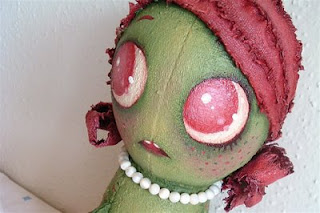
I don't usually go for kitschy crafts, but I suppose there's something about constructing something undeniably cute out of tentacles and a strange green colour that is appeallinig to all demographics--or at least whatever bizarre demographic I fit into.

If you want to know what I'm talking about, go to this link: http://aliciapolicia.blogspot.com/2008/04/octopolly.html. I found this site through Blogs of Note and spent some time looking through back posts (as in back issues; I may have just made this word up). Suddenly this amazing, adorable, tentacled girl appears, and I'm just smitten. At this point I really encourage you to use the link, because otherwise it sounds like I sport some very strange fetishes. Not that I have anything against people with strange fetishes, but, you know... You could also look at the picture to the left, I suppose.

Not that I expect someone to jump down my throat (what an odd expression) about dissing kitschy crafts, but in case someone does, I'd like to pre-empt them. I spent what seemed at the time to be a lot of my childhood at craft shows. In case you don't know what a craft-show is, imagine an annual or semi-annual flea market (or farmer's market or trade fair, if you're more familiar with those) where assorted vendors can sell handicrafts that they make. There's usually a variety of merchandise--my parents originally sold Femo (sp?) jewellery but then moved almost entirely into woodcrafts of the planter, garden stake, bird-feeder, and seasonal decoration variety. My brother and I, in a few of the smaller events, had a table where we sold Christmas ornaments, wooden puzzles, and home-made chocolates. When we were abroad, especially in the US, we would often visit craft shows so that my parents could get ideas to use in Ontario, since they tried to avoid using designs of people circulating the same market; not everyone, incidentally, held the same moral code that they did. During our frequences of craft shows, my brother and I would often hang out in the van or in the trailer (if we brought one, as we often did when selling at larger events) reading, writing, horsing around, and generally staving off boredom. At least once, however, we would go around and see what was all available at a craft show, and sometimes there would be something which would interest one or the other of us. The point of all of this is that kitschy crafts, and non-kitschy crafts, were a formative part of my childhood. They partly defined how I understood employment, how I undertook amusing myself, how I measured seasonal cycles, how I conceived of artistic expression, and how I spent money and engaged in consumer-tourism. I may not decorate with woodcrafts a lot, but you will usually see in the sorts of useless items I bring to school with me a sense of the craft-shows I grew up in.

A while back--just before I left Fort McMurray--I may have mentioned that I was nostalgia-tripping. This is something I have been thinking about a lot lately.

Finally, I want to vent a little about a book I read for class by E. A. Poe, called The Narrative of Arthur Gordon Pym of Nantucket. If the title seems somewhat drawn out and inclusive of irrelevant details, it may be symptomatic of the aimlessness of the work as a whole. In class we determined that it's largely a case of an author screwing with us; I think Poe is trying to figure out how little plot he can include in a book with it still remaining a 'narrative.' He's also trying to figure out how many unrelated 'events'--and here we're stretching the definition of event--he can string together without any real connective tissue, by merit of agentless drifting and spontaneous decision-making. To top it off, the editor of the edition has some mad scheme about hidden allegories Poe is making in the text, something to do with mirroring, Christ-figure revelation, and Poe's love of his mother and brother. The whole reading rests upon similarity in word-choice between select passages in the first chapter and the last half of the book, with some strange relation between albatrosses and penguins. If this seems unlikely and ridiculous to you, that's because it is. The editor is on crack--metaphorically more than literally, though I suppose I can't know that he isn't literally on crack as well. I didn't actually read the introduction he wrote, mind you, but instead surmised this from the assorted endnotes he gives. These endnotes also like to point out where Poe "almost certainly" got the information he included, which seemed far fetched to me and largley irrelevant. For instance, the editor placed an endnote after the word "spermaceti," and I assumed this note would tell us what a spermaceti was, but instead explained which nautical texts Poe lifted his nautical knowledge. Fortunately, I know that spermaceti is neither a pasta nor a reproductive organ but instead a sperm whale, and has I not known this I could have determined it from the fact that cetology is the study of whales, and thus sperm-a-ceti is likely a sperm whale. However, I really doubt your average reader, even of Poe, would have this information. A good editor would include that gloss. This editor chose not to.


Pym, while enjoyable in a masochistic sort of way, is the textual equivalent to LCD, especially at the mind-numbingly improbable end, where water is gelatinous and stratified, and albatrosses migrate out of a top-less spray of sea-foam... and then things implode from there.


Well, that's an insight into the mind of English Clergyman today. I suppose I left out the fascination and speculation on the Canadian Federal Election, and the similar events south of the border. But I can save all of that for later. I'll write a review of it another day.

Monday, 15 September 2008

Tomorrow's Villanelle

I seem to always hear, ‘My, how you’ve grown,’
when talking with parents’ friends, who repeat
until I feel my age is not my own

but instead memories I have on loan,
a ‘When I was as young as you’-like bleat
I seem to always hear as ‘how you’re grown

since I last saw you, taught you,’ in that tone
that writes my past back to my baby teeth
until I feel my age is not my own,

or with old friends I pretend to still know
I’ll reminisce and from their shifting feet
I seem to always hear, ‘My, how you’ve grown

away from us,’ where the stories have flown
to younger crowds, who play my former beat
until I feel my age is not my own.

Other birthdays come, and from each milestone,
in the under-thoughts when my brain’s voice greets,
I seem to always hear, ‘My, how you’ve grown,’
until I feel my age is not my own.

Monday, 10 September 2007

A Different Tonight: A Ghazal


We could have been sitting at the table, reading each other’s tea leaves tonight,/
could be predicting the stories that will happen after your train leaves tonight.

I could have made you a salad, dicing tomatoes over the sink as you sing/
a naughty lullaby and look for bad spots among the lettuce leaves tonight.

The trees are gilded, now, and we could have walked among the birches with/
our gloved hands in our pockets and our feet wading in the leaves tonight.

People in the store would have asked what we are doing buying ice cream/
and as I counted out the dimes I would have said that “he leaves tonight.”

Yesterday, I bought those novels that you liked as a kid, and we could be/
reading aloud to each other as we smelled the newness of the leaves tonight.

Today we are spending time apart from each other because neither of us/
asked to spend it together, and I think the last chance we have leaves tonight.

Sunday, 19 August 2007

Sonnet 2 - Saima

Saima, I with patience write this verse
Near the time that we will move away,
To try to tell how you improved the worse
Parts of tasks, events, the dragging day.
Standing by the microwave at noon,
You would tease my eye by showing shoes,
Make my tongue with sweet desserts to swoon,
And fake our romance, others to confuse.
I will miss our summer bonding weeks,
Tattooed thistle etch'd on shoulder brown,
Secret notes in bunks, your laughing cheeks,
And talks while driving home across the town.
So when I freeze in Kingston's winter cold
I will Saima's warm remembrance hold.


See other sonnet for explanation.

Friday, 3 August 2007

Sonnet 1 - Kristy

Your absence, darling Kristy, rents my heart;
When you with inner eye I try to see,
In your missing space goes every part
That made that organ you had torn from me.
Morning opens clouded o'er in pain:
I seek your smiling face, my fleecy lamb,
Your laughter's lifting Nova Scotian strain,
And find the park a Kristy-lacking sham.
I know that you will still return some day
To flash your shutter, sealing moments rare
On film and heart with all-enchanting ray,
To whisper his, and here your beauty share,
Yet after peachy times, you leave
This park alone, and lonely me bereaved.

I dislike disclaimers, but know nonetheless that this is supposed to be ridiculous, and is laden with inside jokes. I wouldn't use 'peachy' if it didn't mean something else.
Blog Widget by LinkWithin